Padel technique · 9 min
Improve your víbora: side spin, pressure and safer targets
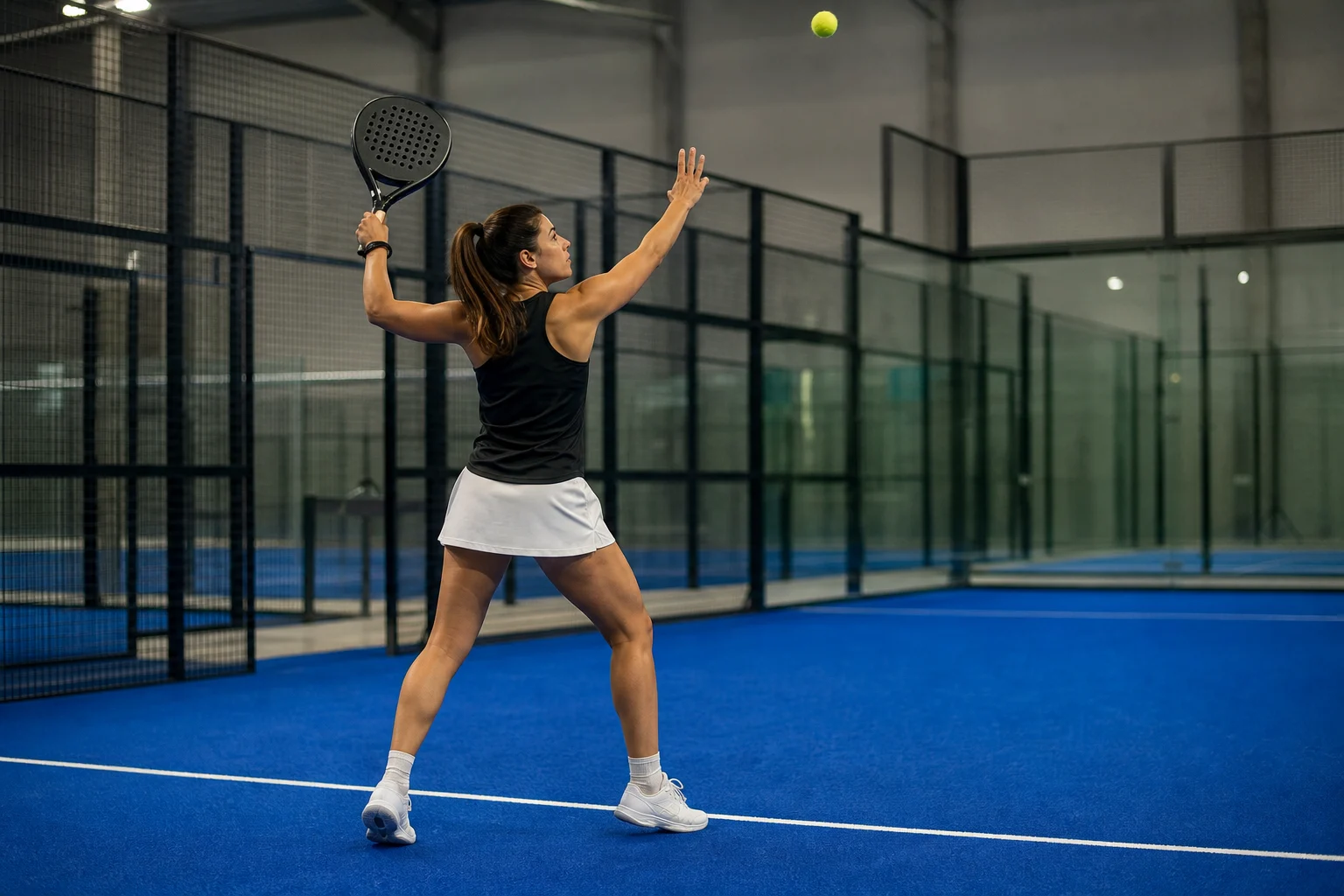
The víbora is not simply another smash. It combines a compact overhead with side spin to keep defenders deep and create an awkward rebound without casually surrendering the net.
PadelLens.AI editorial team
Published 20 July 2026
Training guidance for recreational players. Not a substitute for individual coaching.
The essentials in 20 seconds
- • Play aggressively only with time and balance
- • Organise contact to the side and slightly in front
- • Brush forwards and across, not only down
- • Prioritise depth, fence pressure and awkward rebound
Pressure, not gambling
When is the víbora better than a bandeja or smash?
Use the víbora on a reachable lob when you can stay balanced and add pressure beyond a bandeja. Side spin changes flight and rebound; the common goal is a weak next ball, not an immediate winner.
If the lob drives you deep, choose bandeja. If it sits short and high, smash may be available. The víbora sits between them: attacking intent with controlled selection.
| Shot | Intent | Typical spin | Good situation |
|---|---|---|---|
| Bandeja | Hold the net | slice | deep or awkward lob |
| Víbora | Build pressure | side-spin / side-slice | time and balance |
| Smash | Finish | flat or topspin | short high lob |
Technique
The víbora in five steps
- 1
Read lob and position
Split early and ask whether you can stop and drive forwards through the ball. If not, choose control.
- 2
Turn side-on and create space
Rotate shoulders and hips. The left hand tracks while small steps keep the ball to the right and in front.
- 3
Prepare high and compact
Keep space under the right elbow and a slightly closed face. Avoid an oversized tennis backswing.
- 4
Brush across and forwards
Contact to the right between shoulder and head height, slightly in front. Travel through and around the outside of the ball.
- 5
Release forwards and close
Finish across the body, stay balanced and move up with your partner.
Movement sequence
Position, lateral contact, forward pressure
- 01
Create lateral room
Keep the ball to the right and slightly in front.
- 02
Through the outside
Forward path with controlled side spin.
- 03
Close the net
Release forwards and read your partner.
Contact point
SIDE + FRONT
To your right, with room from the body
For a right-hander the ball is on the right between shoulder and head height, slightly in front, leaving room to brush forwards and across.
- Racket in right hand; left hand balances
- Space prevents a trapped elbow
- Contact stays ahead of the shoulder line
Self-diagnosis
Five víbora mistakes and their fixes
You play it leaning back
Spin becomes random and the net is lost.
Fix: Choose bandeja when you cannot stop.
Spin comes only from the wrist
The face changes uncontrollably.
Fix: Lead with shoulder rotation and forward travel.
You chop straight down
The ball lands short or in the net.
Fix: Brush across while still travelling through the target.
Contact crowds the body
The elbow jams and the face opens late.
Fix: Use small steps to create lateral space.
You force the angle
A narrow fence target raises errors and opens court.
Fix: Build depth first, then narrow the target.
Training
Three drills for controlled side spin
Across and through
Mark contact to the right and in front. Move forwards and across without flicking the wrist.
Depth before angle
Play at 60 percent deep to the rear glass. Count rebounds that keep pressure.
Glass, body, middle
Keep preparation identical and change only direction.
Video analysis
How to film your víbora
A rear-side view shows spacing, contact and racket path. Include landing and net recovery.
Position
Behind and to the right hitting side, not straight through the net.
Height
Chest height for shoulder line and lateral contact.
Frame
Full body, ball above head and two recovery steps; do not zoom.
FAQ
Common questions about the víbora
How is it different from a bandeja?
Bandeja prioritises control and slice. Víbora adds side spin and pace from a better position.
Should it finish the point?
Usually it creates an awkward rebound and weak next ball rather than winning immediately.
Where does a right-hander contact?
To the right and slightly in front, commonly between shoulder and head height.
Does spin come from the wrist?
Not alone. Position, shoulder rotation, forearm and a forward-across path create stable spin.
Is it for beginners?
Build a controlled bandeja and reliable overhead contact first.
Sources and technical note
The core technique is supported primarily by The Padel School and Padel.how; PadelMBA and LTA add curriculum context. Spin and grip details vary individually.